WattList may earn a commission if you buy through links on this page, at no extra cost to you. Rankings are not for sale. Samples are disclosed when a brand provided the unit.
Manufacturer specifications and public offer information checked November 7, 2026 (ET). This is a desk-researched comparison of published specifications and manuals. We have not tested these units.
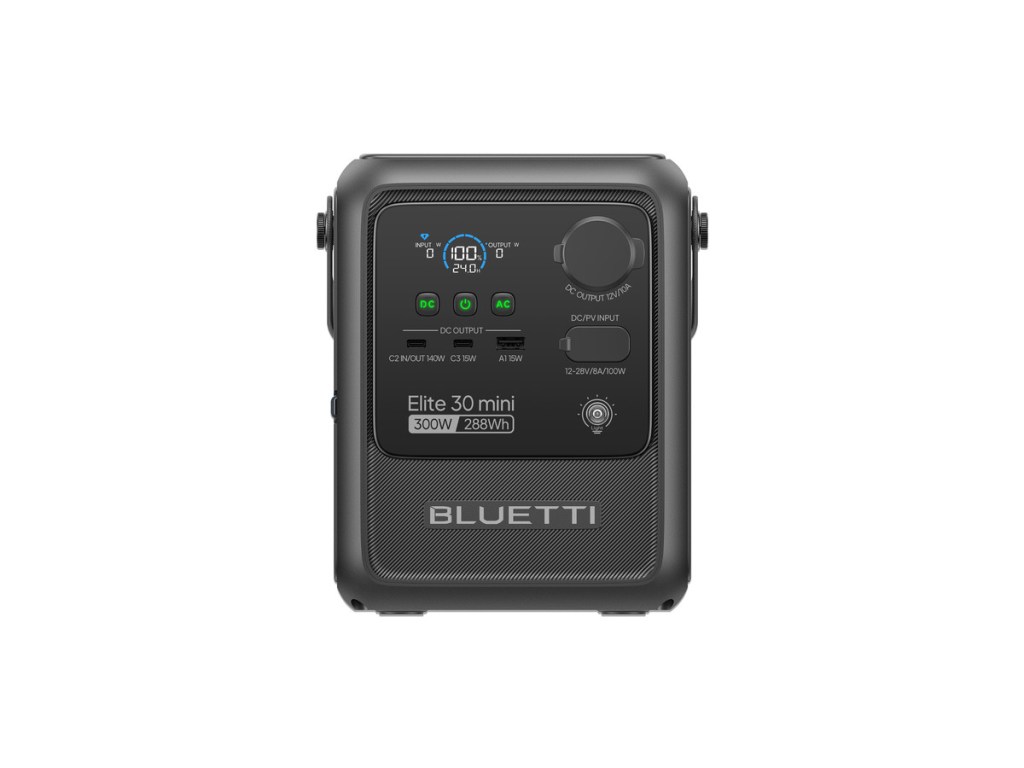
The BLUETTI Elite 30 mini puts a 288Wh battery and a retractable 140W USB-C cable in a 7.3 lb package. The EcoFlow RIVER 3 weighs a little more, stores 245Wh and advertises a one-hour wall recharge. Anker’s C300 AC weighs 9.1 lb and gives you three AC outlets plus two high-power USB-C outputs.
All three have 300W of rated AC output. That makes this a comparison for laptops, cameras, lights, fans and short communications outages. A larger wattage printed beside “Power Lifting,” “X-Boost” or “SurgePad” does not turn any of them into a conventional 600W inverter.
For a mobile laptop setup, the Elite 30 mini has the strongest portability case on paper, provided its shipping timing works for you. The RIVER 3 offers a slightly heavier, smaller-capacity alternative; its current US offer is not verified here. The C300 makes sense when its extra AC sockets and USB-C outputs solve a specific problem. Its battery holds the same rated energy as the BLUETTI.
Compare the exact models
The specifications below describe the named base stations, without solar panels. The BLUETTI price is a public manufacturer-store snapshot before tax. Current US offers for the other two models are not verified, and no shopping links or current-stock recommendations are provided for them.
| Model | Rated capacity | Continuous AC output | Weight | US price and availability |
|---|---|---|---|---|
| BLUETTI Elite 30 mini | 288Wh | 300W | 7.3 lb | $249.99 in BLUETTI’s public product data; available=true is an orderability flag, not dispatch proof. Its page says “ships from early November”; actual shipping timing is unconfirmed. |
EcoFlow RIVER 3 (245Wh), manufacturer specifications: 245Wh, 300W rated AC, approximately 7.7–7.8 lb depending on the published rounding. Current exact US offer and seller are not verified.
Anker SOLIX C300 AC (A1722), US manufacturer specifications: 288Wh, 300W shared AC output, 9.1 lb. Current US seller and offer are not verified.
The two 288Wh models store about 18% more rated energy than the 245Wh RIVER 3. That is a capacity comparison, not a measured runtime advantage. Inverter overhead, output choice and low-load behavior can change the result.
The C300 weighs 1.8 lb more than the BLUETTI. Its extra AC sockets do not add battery capacity.
Sources: BLUETTI product page, EcoFlow manufacturer specifications, Anker US product page, and the manufacturer manuals linked below.
What the Elite 30 mini adds
The retractable cable is the practical reason to start with the Elite 30 mini. It supplies up to 140W to a compatible USB-C device and can also recharge the station from a suitable charger. A separate 140W USB-C port gives you another input/output connection. The manual allows both to recharge the battery together, up to 280W, with appropriate chargers and cables.
Its 288Wh capacity matches the C300 while its stated weight is 1.8 lb lower. For a laptop, camera batteries and phones on a road trip, that is a useful combination. USB-C avoids running an AC laptop charger when your laptop supports the station’s charging profile.
There are limits. BLUETTI rates the station’s combined AC and DC output at 300W; the port ratings do not all add together. The solar input is 100W maximum, not the 200W rating of the separate Elite 30 V2. The names are easy to confuse.
BLUETTI’s public page labels the mini “NEW” and says it ships from early November. We have not confirmed that individual orders are dispatching. This comparison does not assume an affiliate launch coupon, special deadline or extra discount.
Charging differences that affect a trip
| Model | Wall charging | USB-C recharging | Solar input | Car charging |
|---|---|---|---|---|
| BLUETTI Elite 30 mini | 300W max in Turbo; manual estimates 80% in 56 minutes, or 130 minutes for a full Standard-mode charge | Two 140W input/output connections; up to 280W combined with suitable chargers | 100W max; 12–28V, 8A max via XT60 | Up to 100W from supported 12V/24V socket |
RIVER 3 charging: Manufacturer claims a one-hour full AC recharge and 110W solar input. Official indexed US-manual excerpts supplied by the parent list a 100W USB-C output, not USB-C recharge input, and 12V/24V car charging up to 100W. The exact rendered manual remains inaccessible; confirm the model label before relying on variant-specific specifications.
C300 AC charging: 330W maximum AC input; advertised 80% in 50 minutes. USB-C2 accepts up to 140W; USB-C3 is output only. Solar input is 100W maximum, 11–28V and 8.2A; car and solar charging cables are sold separately.
Recharge times are manufacturer claims under different conditions. An 80% time is not directly comparable to a 100% time, and peak input power does not persist through a full charge.
The Elite 30 mini’s sales page advertises 80% in 46 minutes and full charging in 103 minutes without enough context to reconcile those figures with the manual. The current support-linked US manual also specifies 80% in 56 minutes in Turbo mode and 130 minutes for a full Standard-mode charge. The table uses those mode-specific figures rather than declaring a charging-speed winner.
For USB-C charging, budget for the charger as well as the station. The mini’s 280W combined input needs two suitable 140W chargers. The C300 has two 140W USB-C outputs, but only USB-C2 recharges the battery. Its “360W total output” specification is a combined-output figure; AC remains limited to 300W.
A 100W panel will not deliver 100W throughout the day. Shade, angle, cloud and heat affect recovery. Match the panel’s open-circuit voltage to the station’s input limit, including cold-weather voltage rise. Keep the station itself dry and shaded.
Sources: Elite 30 mini US manual, C300 official US manual, EcoFlow US series page, and EcoFlow’s RIVER 3 manufacturer specifications. The latter is a Canadian product page used for shared model specifications, not US availability or price; exact US manual and offer checks remain separate.
Road travel, camping and light backup
Road travel and laptop work
The Elite 30 mini is the first model to consider if carrying weight and a built-in laptop cable are the priorities. Confirm that your laptop accepts its USB-C profile; a 140W port does not make every laptop charge at 140W. Carry a separate compatible cable if cable redundancy matters.
The RIVER 3 is roughly half a pound heavier and claims a full wall recharge in an hour. Its published specifications fit the same light-load role when 245Wh covers the day, but a current exact US offer still needs checking.
Light camping
For lights, phones and camera charging, build a Wh budget before choosing. The C300’s three AC outlets are useful for several small chargers, but they share a 300W ceiling. They do not create extra battery capacity. Choose on the connections you will actually use, after comparing verified current offers.
A cooler changes the calculation. A hypothetical 40W average load over eight hours uses 320Wh at the device, already more than any of these batteries stores before losses. A cycling cooler may average less, but its startup demand and hot-weather consumption still need checking.
A short router outage
BLUETTI’s manual specifies UPS transfer in 10ms or less, Anker’s US guide specifies under 10ms, while RIVER 3 transfer timing depends on the variant. EcoFlow product copy advertises under 20ms, while indexed manual excerpts distinguish a 10ms UPS version. Do not assume the faster timing from the base model name alone. These specifications do not guarantee that every connected device will ride through the transfer.
Measure the router, modem and any mesh nodes together. A station with enough output watts can still run out of energy before the outage ends. Low-load shutdown settings and behavior after battery depletion also matter for unattended backup. None of these recommendations is for life-support equipment.
Runtime without the brochure promises
A simple planning example shows the scale. Assume 80% of rated capacity reaches a steady 30W AC load. That assumption gives 196Wh from a 245Wh battery and 230.4Wh from a 288Wh battery: roughly 6.5 and 7.7 hours respectively.
Those are calculations, not test results or promised runtimes. Actual AC overhead can be especially important with tiny loads, and age, temperature and settings affect usable energy. Leave reserve capacity rather than sizing an outage plan to the last minute.
For a fuller load worksheet, use WattList’s Wh sizing guide. If the calculation already exceeds this small class, the under-$500 guide covers larger batteries instead of treating every budget station as equally portable.
Similar names that change the purchase
RIVER 3 Plus: The 286Wh Plus has a genuinely higher 600W rated inverter and supports extra batteries. It is a useful alternative when 300W is too restrictive. We have not verified a current purchasable US offer for the exact 286Wh base unit, so it is outside the buying table. Do not substitute a 268Wh Plus 270 listing or a bundle without checking the specifications and total price.
C300 DC: Anker’s A1726 has no AC outlets. Its advertised 300W refers to DC output. The A1722 C300 AC compared here has AC sockets and weighs more. A lower-priced DC listing is not the same offer.
Jackery Explorer 300 Plus: The US URL we checked resolves to Explorer 300 v2 content, which says sold out. We have not treated that as a verified current offer for the older Plus.
Boost modes: BLUETTI’s Power Lifting mode is intended for specified resistive loads. Its manual separately lists time-limited surge capability, including 450–600W for three seconds at at least 60% charge. Anker’s US manual says SurgePad is unsuitable for precision instruments and devices with strict voltage requirements, and does not operate in bypass mode. Its 600W SurgePad and EcoFlow’s 600W X-Boost are separate from the 300W rated AC output. Do not use those mode numbers as proof a compressor, pump or sensitive appliance will start.
Before ordering, check the exact model, seller, included cables and dispatch estimate. If your requirement is “keep a 40W average load running for eight hours,” start above 320Wh before adding conversion losses and reserve.


Leave a Reply